
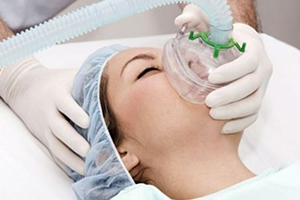
 What is general anesthesia?
General anesthesia, commonly known as being put to sleep, is achieved with a combination of three groups of medications.
1. Hypnotic drugs cause a temporary loss of consciousness.
2. Narcotic analgesics (morphine-like pain relievers) ensure that the patient undergoes a pain-free procedure even while unconscious.
3. Muscle relaxants relax all the muscles in the body to provide a comfortable surgical environment. With muscle relaxants, all muscles, including the breathing muscles, are temporarily paralyzed. A small sterile tube called an endotracheal tube is placed in the patient's windpipe (trachea), and the patient's breathing is provided by an anesthesia machine (ventilator) under the control of the anesthesiologist.
General anesthesia is then maintained with gases such as an oxygen/air or oxygen/nitrous oxide mixture, along with volatile agents (such as sevoflurane).
Anesthesia Complications
With recent advances in medicine, the side effects of the drugs used in anesthesia are quite minimal, and they are eliminated from the body quickly. In addition, with today's medical technology, all of the patient's vital signs can be monitored very closely, both through anesthesia equipment and patient monitoring. For this reason, as long as it is performed by qualified professionals under appropriate conditions, complications related to anesthesia (general or sedation)
are quite rare. What every anesthesiologist fears most is a patient who has a full stomach. If the patient vomits during full anesthesia and the vomit reaches the lungs, it can lead to a very serious and potentially fatal lung infection (pneumonia). For this reason, we strongly ask our patients to fast for at least 8
hours (as if fasting). The first rule of minimizing complications is a detailed pre-op (before surgery) anesthesia examination of the patient.
Patient groups for whom we use general anesthesia and sedation
We can divide child and adult patients into 5 groups.
1. Children younger than 4 years: dental treatment through persuasion is quite difficult for this group.
2. Children or adults with developmental delay
3. Adult patients with severe phobia (fear)
4. Surgical procedures that require general anesthesia (bone grafts, bone cysts, etc.)
5. Patients who want many surgical procedures, which cannot be done in a single session under local anesthesia, to be completed in a short time (2-3 hours) under general anesthesia
Dental Treatment under General Anesthesia for Children
Dental treatment for children can be performed under general anesthesia. It is especially preferred for children under 6 or patients with disabilities. Because the patient is unconscious during general anesthesia, dental treatment can be completed completely painlessly and in a single session, especially for children who have trouble cooperating. Dental treatment under general anesthesia for children covers all teeth in the mouth that need treatment. In other words,
all dental treatments can be completed in a few hours in one go while the child is under anesthesia. After the necessary checks following general anesthesia, it is generally a procedure that does not require an overnight stay, and the patient goes home the same day.
What are the advantages of dental treatment under general anesthesia for children?
The greatest advantage of dental treatment under general anesthesia is that it can be performed on uncooperative patients without causing any fear. Another important advantage is that all dental treatments can be completed in a single session.
Is general anesthesia harmful?
All medical treatments carry risks and side effects. Just as with general anesthesia, a child who does not want to be treated in the dental chair faces risks both from the untreated teeth and from their behavior during dental treatment. What matters is to take all precautions for every treatment and follow the healthiest and least harmful path. As a result, the most suitable treatment should be chosen by evaluating all risks in terms of oral condition and general health.
Where and how is dental treatment under general anesthesia performed?
Dental treatment under general anesthesia is performed by the dentist in a fully equipped operating room under the supervision of a specialist anesthesiologist. A mobile dental unit specially designed for dental treatment under general anesthesia allows all dental treatments to be completed fully.
Does general anesthesia affect dental treatment?
General anesthesia has no negative effect on dental treatment. On the contrary, since there is no need to communicate with the patient, dental treatments can be performed in a nearly flawless way.
Who can have general anesthesia?
General anesthesia can be given to people who have no chronic illness affecting their general health and who are found suitable after being examined by a specialist physician for general anesthesia.
How long does dental treatment under general anesthesia take?
Dental treatment under general anesthesia varies depending on the number of teeth to be treated and the procedures to be performed. It generally takes between 1 and 3 hours.
What should be considered after general anesthesia?
After general anesthesia, all checks are performed on the patient by the anesthesiologist in the recovery room, and the patient is kept under observation for a few hours up to a day.
It is necessary to attend the follow-up appointments given for dental treatment regularly. What matters at this stage is not to repeat the factors that caused earlier dental problems after treatment, and to follow the dentist's recommendations on nutrition and oral hygiene.